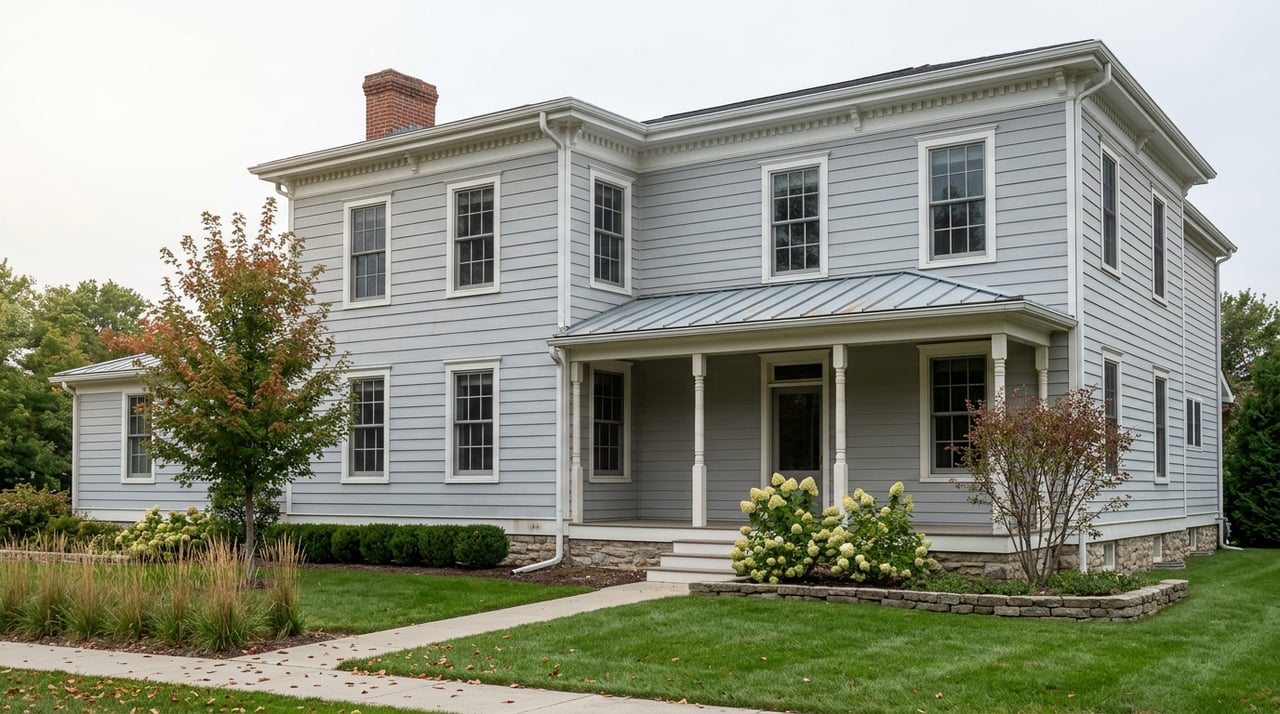
Do you need the city's permission to repaint your house?
If you own one of the Victorian homes on the streets radiating off Woodstock Square, that's not a rhetorical question. It's the one that stalls a lot of pre-listing projects, because two different kinds of "historic" apply to that part of town, and they don't require the same things from you.
The Square Carries Two Labels, Not One
In 1982, the entire downtown area, including the Old McHenry County Courthouse from 1857 and the Woodstock Opera House from 1889, was listed on the National Register of Historic Places as the Woodstock Square Historic District. The city's own history page describes the Victorian homes surrounding the square as part of that same historic district, and notes that many of them have received plaques from the Historic Preservation Commission recognizing their architectural significance.
That's one label. It's honorary. National Register listing doesn't require an owner to ask permission before painting, re-siding, or replacing windows, and it doesn't come with a design review board looking over your shoulder.
The second label is narrower and does come with rules. In January 1996, the City Council adopted an ordinance creating the Downtown Business Historic District and establishing the Historic Preservation Commission. Properties inside that specific district need a Certificate of Appropriateness before any exterior construction or alteration begins.
The name matters here. It's the Downtown Business Historic District, not the residential blocks around it. A homeowner three streets off the square who assumes they're bound by the same permitting process as the storefronts on the square itself is usually operating on an assumption the city's own naming convention doesn't support.
Here's the practical read, in plain terms:
If your Victorian sits inside the 1982 National Register footprint but outside the 1996 Downtown Business Historic District, you don't need a Certificate of Appropriateness to touch your exterior. You do need one if your parcel falls inside the smaller regulated district, which is centered on the commercial buildings ringing the square.
| National Register District (1982) | Downtown Business Historic District (1996) | |
|---|---|---|
| What it covers | The entire downtown area, including surrounding Victorian residential streets | Commercial properties on and immediately around the square |
| Permission needed for exterior work | No | Yes, a Certificate of Appropriateness |
| Who reviews changes | No local review body | Building & Zoning Department (Category I) or the Historic Preservation Commission (Category II) |
| Main practical value | Design consistency for the storefronts framing the square |
How to Find Out Which One Applies to Your Address
You don't have to guess. Call the Building and Zoning Department at Woodstock City Hall, 121 W. Calhoun Street, before you get bids. The city itself recommends reaching out early in the planning process so staff can identify which category, if any, your project falls into and walk you through what's required.
If you're outside that district, which most of the Victorian homes on the residential streets are, you can move straight to a standard building permit for the work itself. No design hearing, no Certificate of Appropriateness.
The Financial Upside Most Owners Never Apply For
Here's where the honorary label turns out to matter more than people expect. The Illinois Department of Natural Resources runs a Property Tax Assessment Freeze Program for owner-occupied historic homes, and Woodstock is on the state's current list of municipalities approved to participate.
To qualify, the home has to be your principal residence, and the Illinois State Historic Preservation Office says your rehabilitation spend has to equal or exceed 25 percent of the assessor's Fair Cash Value within a 24-month window. The work has to meet the Secretary of the Interior's Standards for Rehabilitation, which in practice means retaining street-visible historic windows and the character-defining features in main rooms, while giving you free rein on kitchens, baths, and back bedrooms. Eligible expenses are broader than most owners assume: new roofs, repointing, window repair, electrical and mechanical upgrades, even solar panels and new additions all count.
Hit the threshold and the reward is real. Your assessed value freezes at its pre-rehab level for eight years, then steps up over four more, for twelve years of reduced assessment. It doesn't freeze your tax rate or the multiplier the county applies, but it takes the rehab-driven jump in assessed value off the table for over a decade.
Woodstock's own listing data gives a rough sense of scale. Homes here were listing at a median of $419,000 in September 2026, according to Movoto. That's not the same number as your assessor's Fair Cash Value, which you'll find on your tax bill, but if your figure lands anywhere close to that range, 25 percent works out to real money, not a fresh coat of trim paint. This is exactly the incentive that owners in the residential streets around the square tend to overlook
What the Exterior Actually Costs to Get Right
If you're weighing whether a rehab project gets you anywhere near that 25 percent line, the exterior alone is a meaningful chunk. Full siding replacement on a typically sized Woodstock home commonly runs $25,000 to $35,000 using fiber cement or engineered wood siding, and homes close to the square tend to land at the higher end because matching original trim profiles takes more labor than a standard job.
Woodstock's winters add their own math. The area gets more than 35 inches of snow and dozens of freeze-thaw cycles a year, and homes along Route 47 with west-facing exposure see their siding deteriorate 30 to 40 percent faster than protected walls elsewhere on the same house. If your Victorian sits along that corridor, the timeline for needing exterior work isn't hypothetical.
None of this changes whether you need a Certificate of Appropriateness. That still depends entirely on which district your parcel sits in. But it does mean that siding, paired with a roof and updated systems, is realistically the kind of package that clears the 25 percent bar for owners who were already planning to do the work.
Proof the Process Works at Scale
If you want to see what a large, fully compliant rehabilitation looks like inside this framework, the Old Courthouse Center is the local example. The Old McHenry County Courthouse, the Old Sheriff's House, and the Jailhouse underwent their first major renovation in nearly half a century, completed in summer 2023. The project modernized the buildings while preserving details like the hand-painted ceiling in the main courtroom. It's a commercial project, so it went through the Downtown Business Historic District's review process rather than the honorary residential track, but it shows that ambitious work and historic character aren't in conflict here. The commission has a track record of approving real change.
A Few Straight Answers
Do I need a Certificate of Appropriateness to repaint my house near the square? Only if your specific parcel sits inside the 1996 Downtown Business Historic District. Most of the residential Victorian homes surrounding the square don't. Call the Building and Zoning Department to confirm your address.
Does National Register listing lower my property taxes automatically? No. The listing itself doesn't change your assessment.
If I'm planning a big rehab, when should I start the paperwork? Before you sign a contract with anyone. Confirm your district status, and if you're pursuing the tax freeze, contact the Illinois State Historic Preservation Office early since their review process differs from the local landmarks review and can take time to coordinate.
If you're weighing whether to update a Victorian near the square before listing, or you're looking at one of these homes as a buyer and want to know what you'd actually be signing up for, Mandy Montford works this exact stretch of McHenry County and can help you sort out which rules apply before you spend a dollar on the wrong assumption. Let's Connect.
This article is general information, not legal, tax or financial advice. Consult a qualified professional about your situation.